
The $400 Savings Question: When AWS Cost Optimization Is Actually Worth Your Time
A founder's framework for deciding when to optimize AWS costs and when to ship features instead. Why "engineering time vs. cost saved" is the wrong calculation, and what to use instead.
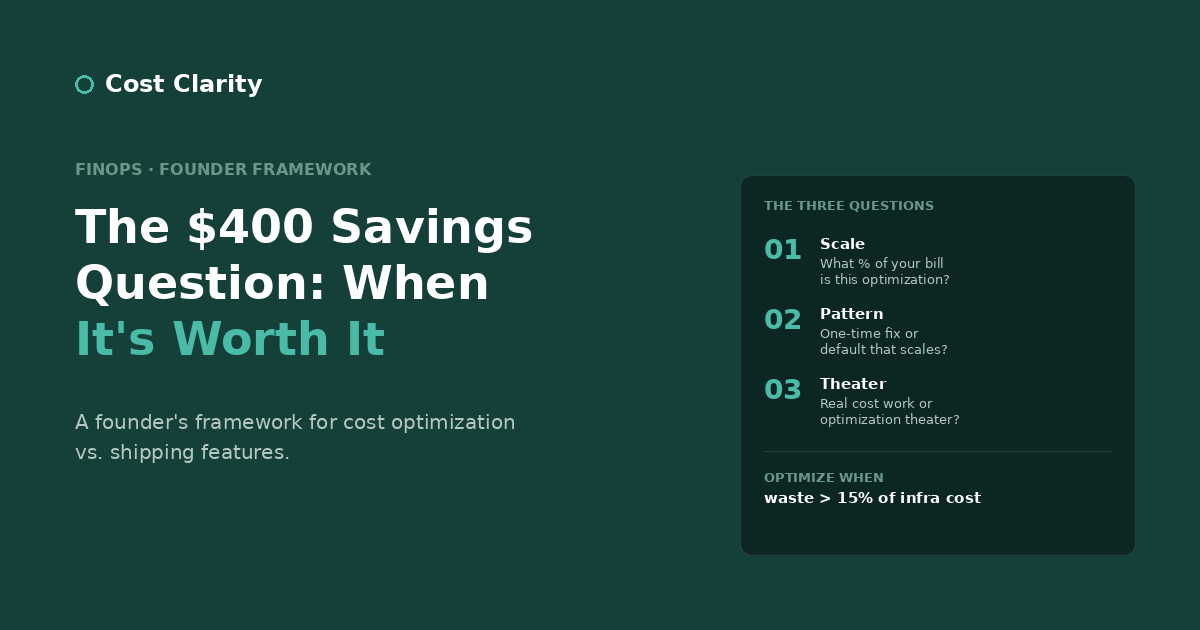
We posted about cutting nearly $400 a month from our AWS data transfer bill. The most interesting part of the conversation that followed wasn't about VPC Endpoints or NAT Gateways. It was a comment someone left that, paraphrased, said: how much engineering time did you spend chasing $400 a month when you could have been building features your customers want?
Fair question. Worth answering seriously.
The standard framing for cost optimization ROI is wrong, or at least incomplete. "We spent X engineering hours and saved Y dollars per month" produces a payback period and stops there. For a startup, that calculation misses what actually matters: whether the work changes what your future bill looks like, whether the patterns transfer, and whether the time you spent is time you could have spent shipping product. This post is the framework we use when those questions come up.
The Naive Calculation
The simple version goes like this: half a day of engineering time at, say, $400 fully-loaded cost. Saves $400/month, $4,800/year. Payback in one month, ROI is enormous.
This makes cost optimization look like a free lunch. It isn't, because the calculation ignores three things:
- What you didn't ship instead. Half a day spent on cost optimization is half a day not spent on the product roadmap. For a pre-PMF startup, that's an enormous opportunity cost the dollar math doesn't capture.
- Whether the savings persist. A $400/month optimization that survives one architecture migration is worth $4,800. One that survives ten years of infrastructure changes is worth $48,000.
- Whether the patterns scale. A NAT Gateway optimization on one VPC saves $120/month. The same pattern applied across the next eight VPCs you'll create over the next two years saves $1,000+/month at maturity. The first instance is the expensive one. The rest are nearly free.
Once you account for these, the picture becomes both more nuanced and—usually—more favorable to optimization. But not always, and not for everyone.
The Real Framework: Three Questions
Before spending engineering time on cost optimization, ask these three questions. The answers will tell you whether to do it now, do it later, or skip it entirely.
1. What's your current AWS spend, and what fraction is the optimization addressing?
This is the most important question, and the one most founders get wrong by reflexively saying "every dollar matters."
Every dollar does matter, but engineering time matters more, and the relationship between them depends on your scale. A few rough thresholds we've found useful:
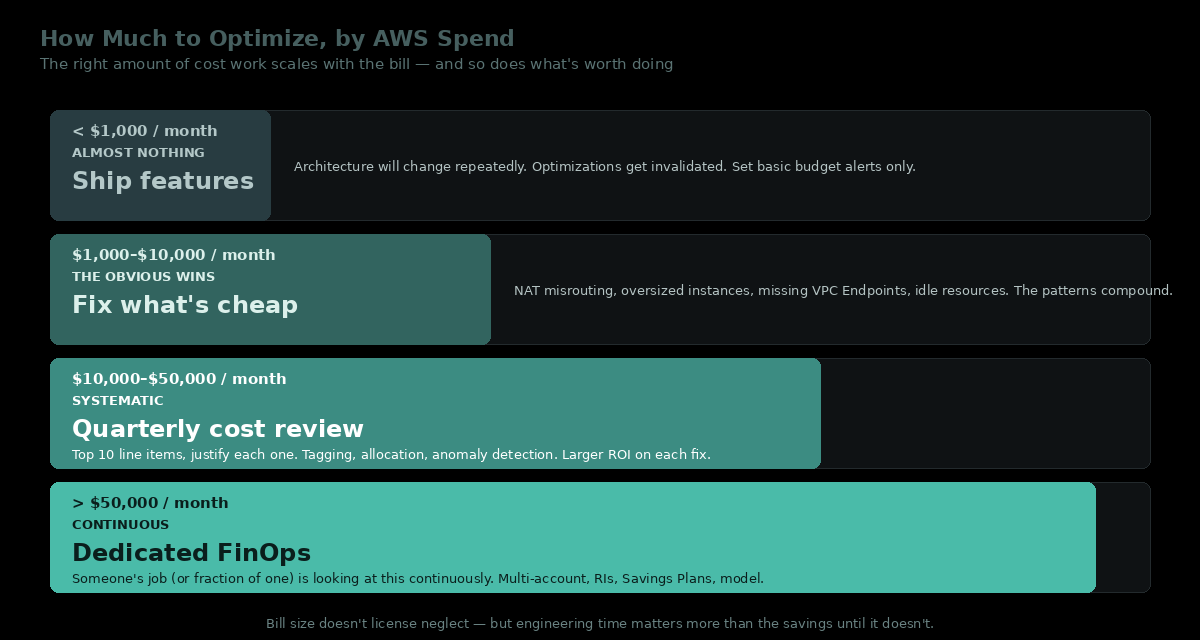
- Under $1,000/month total AWS spend: Optimize almost nothing. You're early enough that architecture is going to change repeatedly, and any optimization you do is likely to be undone or invalidated within months. Set up basic cost alerts so you don't get surprised, and ship product.
- $1,000–$10,000/month: Optimize the obvious problems. NAT Gateway misrouting, oversized instances, idle resources, missing VPC Endpoints. The fixes are cheap, the patterns are well-known, and the savings compound as you scale.
- $10,000–$50,000/month: Optimize systematically. Run a quarterly cost review. Identify the top 10 line items by cost and ask whether each one is justified. The investments that pay back here are larger, but so are the ongoing savings. This is also the spend range where the multi-account vs. tags question starts getting real.
- Over $50,000/month: You probably need a dedicated FinOps function or external help. The optimization opportunities are large enough that someone's job—or part of someone's job—should be looking at them continuously.
The $400/month optimization in our case represented roughly 8–10% of our AWS bill at the time. That's a meaningful chunk, well above the threshold where it's worth the engineering time.
If a $400 optimization represents 0.5% of your bill, it's still worth doing eventually, but it's not urgent. If it represents 20% of your bill, you should probably already be doing it.
2. Is the optimization a one-time fix or a pattern that prevents recurrence?
This is the question the simple ROI calculation misses entirely.
Some optimizations are point fixes. You found an oversized RDS instance, you right-sized it, you saved $300/month. The fix is permanent (until traffic patterns change), but the work doesn't transfer to anything else. The math is the simple math: hours invested versus monthly savings.
Other optimizations install patterns. You found that NAT Gateway data processing was eating $120/month because S3 traffic was routing through it. Fixing it took 10 minutes. But the real value is what happens next: every subsequent VPC you create gets the VPC Endpoint as part of the standard template. The cost you would have generated next year, the year after, on every new environment, is now zero.
The pattern-installing optimizations are the high-leverage ones. They look like point fixes, but they're really deployment defaults that compound. Some examples from our experience:
- VPC Endpoints for S3 and DynamoDB as part of the VPC module
- Required tagging enforced by SCP and OPA (covered in AWS Cost Allocation Tagging: Beyond "Just Tag Everything")
- AWS Budgets created automatically for every new account
- Default CloudWatch log retention set to something other than "forever"
- Right-sizing review built into the deployment pipeline
When you're evaluating an optimization, ask: will this fix prevent the same waste in our next deployment? If yes, it's worth more than the surface math suggests. If no, weigh it against the simple ROI.
3. Is this optimization theater, or does it address an actual cost trajectory?
This is the question that catches most "we should optimize" instincts that should have been "we should ship features instead."
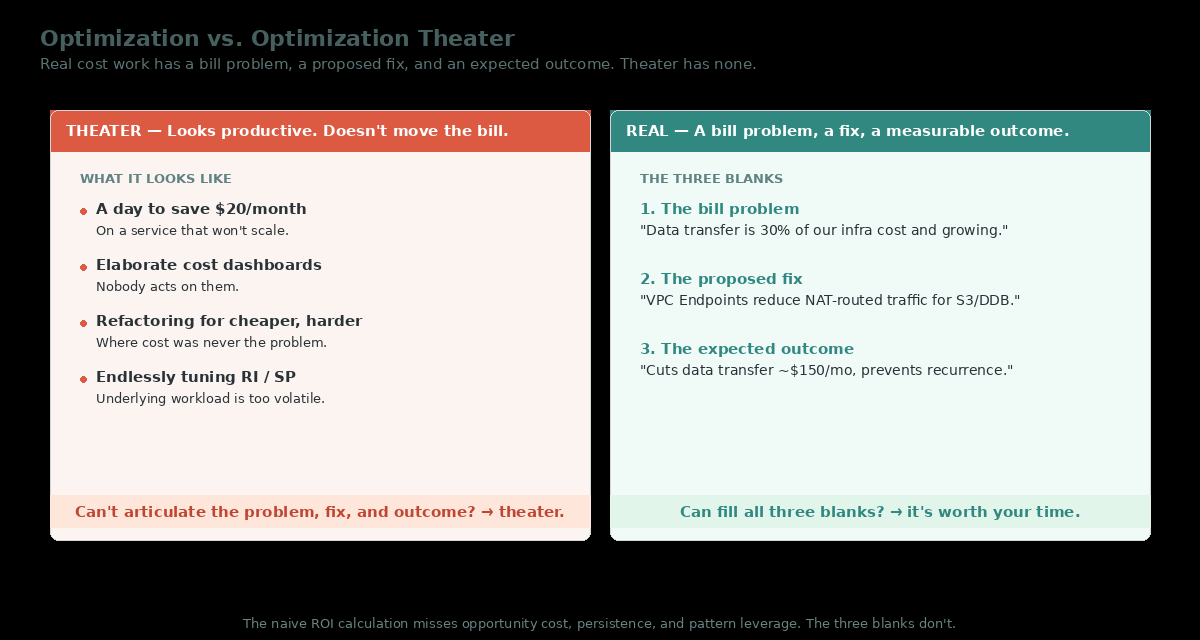
Optimization theater is when a team spends time on cost reductions that feel productive but don't move the bill in any meaningful way. Common patterns:
- Spending a day to save $20/month on a service that's not going to grow.
- Building elaborate dashboards to monitor costs nobody is making decisions about.
- Refactoring a service to use a cheaper but operationally harder pattern, when the cost wasn't a problem in the first place.
- Endlessly tuning Reserved Instance and Savings Plan coverage when the underlying workload is volatile.
Real cost work has a pattern: you can articulate the bill problem ("data transfer is 30% of our infra cost and growing"), the proposed fix ("VPC Endpoints reduce NAT-routed traffic"), and the expected outcome ("cuts data transfer cost by ~$150/month, prevents recurrence in new environments"). If you can't fill in those three blanks clearly, you might be doing theater.
Theater isn't always bad—sometimes the visibility itself is the goal—but it should be a deliberate choice, not a default. For a startup that's runway-constrained, the rule of thumb we use: if the optimization doesn't either save real money or prevent future waste in a way that scales, don't do it now.
Our Rough Rule
Combining the three questions into something you can actually use:
Optimize when:
- Wasted spend exceeds 15% of your infrastructure cost, OR
- You're about to scale a pattern (more environments, more services, more traffic) and the inefficiency would scale with it, OR
- The fix takes less time than ignoring it would cost in attention over the next quarter.
Ship features instead when:
- You're pre-PMF and burning runway on optimization theater, OR
- The optimization is a point fix on a small fraction of your bill, with no compounding effect, OR
- You don't have basic cost visibility yet, in which case set that up first—you can't optimize what you can't measure.
There's a corollary: whether you optimize or not, set up cost visibility from day one. The fixed cost of monitoring is small. The variable cost of not knowing what your bill looks like, especially while you're on AWS credits, is enormous. The founders who get the worst surprises at month 13 of their credit period are the ones who never built the habit of looking.
The Day-One Investments That Always Pay Back
Some things are worth doing regardless of where you fall in the framework above, because the cost is so low and the benefit so durable:
- AWS Budgets with alerts on day one. Set up budgets at 25%, 50%, 75%, 100% of expected monthly run-rate. Five minutes of setup. Catches anomalies before they become invoices.
- Cost allocation tags from day one. Three required tags (
Environment,Service,Team), enforced via SCP. Reduces future investigation time on every cost question you'll ever ask. - VPC Endpoints for S3 and DynamoDB in your VPC template. No reason not to. Pure savings, no operational downside.
- Default CloudWatch log retention. If you don't set retention, AWS keeps logs forever. Set a default of 30 or 90 days unless you have a compliance reason to keep longer.
- Idle resource cleanup automation. Tag resources with a TTL, run a weekly job that cleans up expired ones. Especially valuable for sandbox environments.
None of these are heroic. All of them prevent the kind of waste that compounds. Set them up once and forget about them.
The Honest Argument for Optimization
Stepping back: cost optimization for early-stage startups isn't really about saving the $400. The bill is small, the savings are small, and you have bigger problems.
The argument for doing it anyway is that the habit is what matters. Founders who build cost discipline early end up with infrastructure they can afford to scale. Founders who treat cost as a future problem end up either with cost as a current problem at exactly the wrong moment, or with the kind of architecture migration that takes a quarter to unwind.
The $400/month we saved was not the point. The point was the muscle: knowing how to read the bill, where to look first, what patterns to standardize, when to invest engineering time and when to skip it. That muscle is worth far more than $400/month over the lifetime of a company.
But if you're three engineers, eight months from PMF, looking at a $1,200 monthly AWS bill: ship the product. Set up the alerts, install the basic patterns, and come back to optimization when the bill or the team is big enough to justify it. The framework above is for deciding when that moment has arrived.
TL;DR
- The naive ROI calculation for cost optimization (engineering time vs. monthly savings) misses what actually matters: opportunity cost, whether savings persist, and whether the pattern scales.
- Three questions to ask before optimizing: (1) what's your current spend and what fraction is this addressing, (2) is this a point fix or a pattern that prevents recurrence, (3) is this real cost work or optimization theater.
- Optimize when: waste exceeds 15% of infra cost, you're about to scale a pattern, or the fix is cheaper than ignoring it.
- Ship features instead when: you're pre-PMF, the optimization doesn't compound, or you don't have basic cost visibility yet.
- Always do these regardless: AWS Budgets with alerts, three-tag enforcement, VPC Endpoints in your VPC template, CloudWatch log retention defaults, idle resource cleanup automation.
- The real value of optimization at small scale isn't the dollars saved. It's the muscle of knowing how to read a bill and standardize patterns. That muscle compounds over the lifetime of the company.